Why Difference Must Exist
The Ontological Ground of Complex Systems

In earlier pieces, I explored a recurring structural pattern in how complex systems evolve.
Large systems grow by generating internal differences.
They persist only insofar as those differences can be held together.
A system remains coherent as long as its capacity to stabilize difference keeps pace with the rate at which difference is produced.
When the production of difference begins to outpace the capacity for coordination (the operational expression of stabilization), systems enter a phase of increasing strain, eventually followed by transformation.
This pattern appears across domains.
In biological systems, ecosystems, organizations, and civilizations, the same relationship returns again and again.
At first, this may appear as an empirical observation - a structural regularity visible in sufficiently large and complex systems.
But a deeper question follows.
Why does this pattern appear at all?
Why do systems need to generate difference in order to exist, and why must that difference be continuously integrated?
To approach this question, it is necessary to move one level deeper — from observed behavior to the conditions that make any structure possible in the first place.
The Problem of Determinability
The question is not what exists.
The question is: How is determinability possible at all?
If complete self-equivalence is assumed as a ground condition, then no internal distinction can arise.
No difference.
No relation.
No prioritization.
Without distinction, nothing can be identified or said to exist in any determinate sense.
A state of full equivalence is therefore not a form of reality.
It is the absence of determinability.
The First Condition
If determinability is to become possible, symmetry must be minimally broken.
Not through the introduction of complex structures,
but through a minimal non-equivalence.
This is not one difference among others.
It is the condition that makes all difference possible.
When minimal non-equivalence is present, determinability becomes possible.
Determinability makes differentiation possible.
Differentiation makes stabilization possible.
From this sequence, structure emerges.
From Difference to Stabilized Determinability
What we call reality is not composed of independent substances.
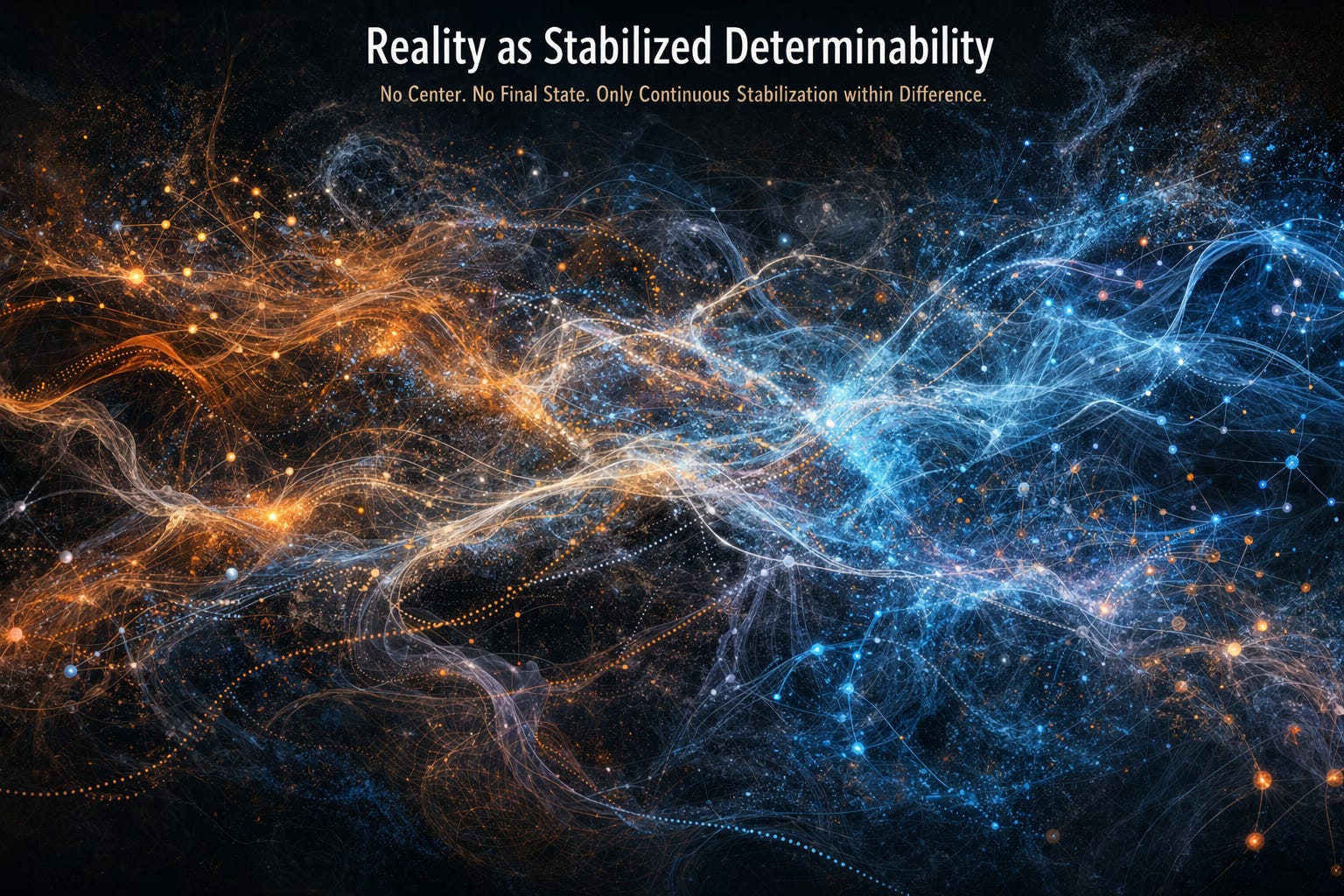
It can be understood as: stabilized determinability over a ground of non-equivalence.
Differences do not merely appear.
They are held.
Maintained across time and interaction.
Stabilization is the temporary maintenance of determinability across difference.
It is never final.
From this, higher-order structures emerge:
logics, identities, forms, systems.
These are not primary.
They are emergent within stabilized determinability.
Operational Clarification
differentiation: number of active, interdependent processes
stabilization: capacity to coordinate, align, and resolve tensions across them
As differentiation increases, stabilization requirements increase accordingly.
Three Concrete Expressions
This structure is visible across levels of reality.
The Cell
A living cell is a stabilized field of differentiated processes.
Gene expression, metabolism, signaling, repair - each is a realized difference.
The cell persists only because these differences are held in relation.
When stabilization fails, differentiation continues without integration.
Cancer is not merely uncontrolled growth.
It is differentiation that is no longer integrated within the organism’s stabilization structure.
The Organization
An organization begins with low differentiation and high implicit coherence.
As it grows, roles specialize.
Functions differentiate.
Structures multiply.
This increases capability.
But it also increases the requirement for stabilization.
If differentiation grows faster than the organization’s capacity to stabilize it - through communication, decision structures, and shared orientation - structural strain emerges.
Decisions slow.
Alignment weakens.
Fragmentation increases.
The State
A modern state is a macro-scale stabilization of vast differentiation.
Economic systems, legal frameworks, infrastructure, cultural variation, technological systems - all represent realized differences.
The state persists only insofar as it stabilizes these differences into a coherent structure.
When realized differentiation expands beyond stabilization capacity, familiar signals emerge: institutional friction, polarization, slower coordination and declining coherence.
These are not isolated failures.
They are expressions of a deeper structural condition.
Structural Recurrence
Seen from this perspective, the pattern observed across systems is not coincidental.
Systems generate differentiation.
They stabilize differentiation.
They persist as long as stabilization is sufficient.
When it is not, transformation follows.
Threshold and Reorganization
Stabilization is never final.
As differentiation increases, the load on stabilization increases.
When differentiation exceeds stabilization capacity, reorganization follows.
This is not an external shock.
It is an internal condition.
Existing structures can no longer be maintained.
New stabilizations emerge.
Symmetry Cannot Sustain Reality
Reducing difference may appear to increase stability.
But symmetry alone cannot produce or sustain structure.
Without difference, nothing can be determined.
Without determination, nothing can persist.
At the same time, uncontrolled differentiation cannot sustain stability.
Stability is the continuous stabilization of difference over a ground that is never fully equivalent.
A Structural Ontology
What began as an observation about complex systems resolves into a more fundamental claim.
Reality is not composed of static entities.
It is composed of stabilized determinability.
Not over a ground of equivalence, but over a ground of non-equivalence.
Difference is not secondary.
It is ontologically primitive.
The Central Proposition
Being is stabilized determinability.
Determinability requires differentiability.
Differentiability requires non-equivalence.
Non-equivalence is ontologically primitive.
What Follows
If this structure holds, then complex systems are not exceptions.
They are expressions.
The relevant question is not whether a system is stable,
but whether its stabilization mechanisms are scaling at the same rate as its differentiation.
This reframes how strain should be understood.
Not as isolated disruption,
but as a signal that stabilization is lagging behind differentiation.
Not as anomaly, but as the precondition for transformation.
What matters, therefore, is to observe:
where differentiation is accelerating
where stabilization is weakening
where the gap between them is widening
At that point, complexity is no longer noise.
It becomes legible as structure.